
Sources for Previous Tullahoma Residents
A backward address trail starts with the era, not a broad name search. The current parcel card leads to the latest recorded transfer. A deed can lead to the seller's earlier purchase. Directories and newspapers add people at an address, while census, funeral, cemetery, and probate sources help distinguish a household from a recorded owner. Tullahoma extends into Coffee and Franklin counties, so first determine which county holds the parcel. The city mailing name alone is not a reliable routing key.
| Source | Years it covers | Where held | What it shows |
|---|---|---|---|
| Coffee Register of Deeds online | Exact start not verified | Coffee recorder and linked index | Recorded instruments, subject to unverified online coverage |
| Franklin Register of Deeds online | Post-July 1998; older deed/trust work noted | Franklin recorder search and office | Party history, book/page, and available images |
| Polk directories | 1998; 2003; 2004-2007; 2009-2015 | TSLA and libraries | Published name and address snapshots |
| Lannom newspapers | 1946-2021 across title runs | Digital archive | Obituaries, notices, local events, and address references |
| Funeral and cemetery sources | 1914-1986 selected funeral runs; 1936 inscription book | TSLA, libraries, Society | Death, family, burial, and time-period clues |
| Federal census | Public through 1950 | Census and FamilySearch routes | Household, age, relationship, occupation, and residence |
For a recent transfer, use the assessor and recorder first. For a mid-century household, the newspaper and directory layers may be faster. For an older land question, stay with the legal description and deed books until the party chain is solid. Each source has a different limit. A directory can show a listed occupant, while a deed shows a recorded instrument and not necessarily who lived there.
Tullahoma Parcel Records First
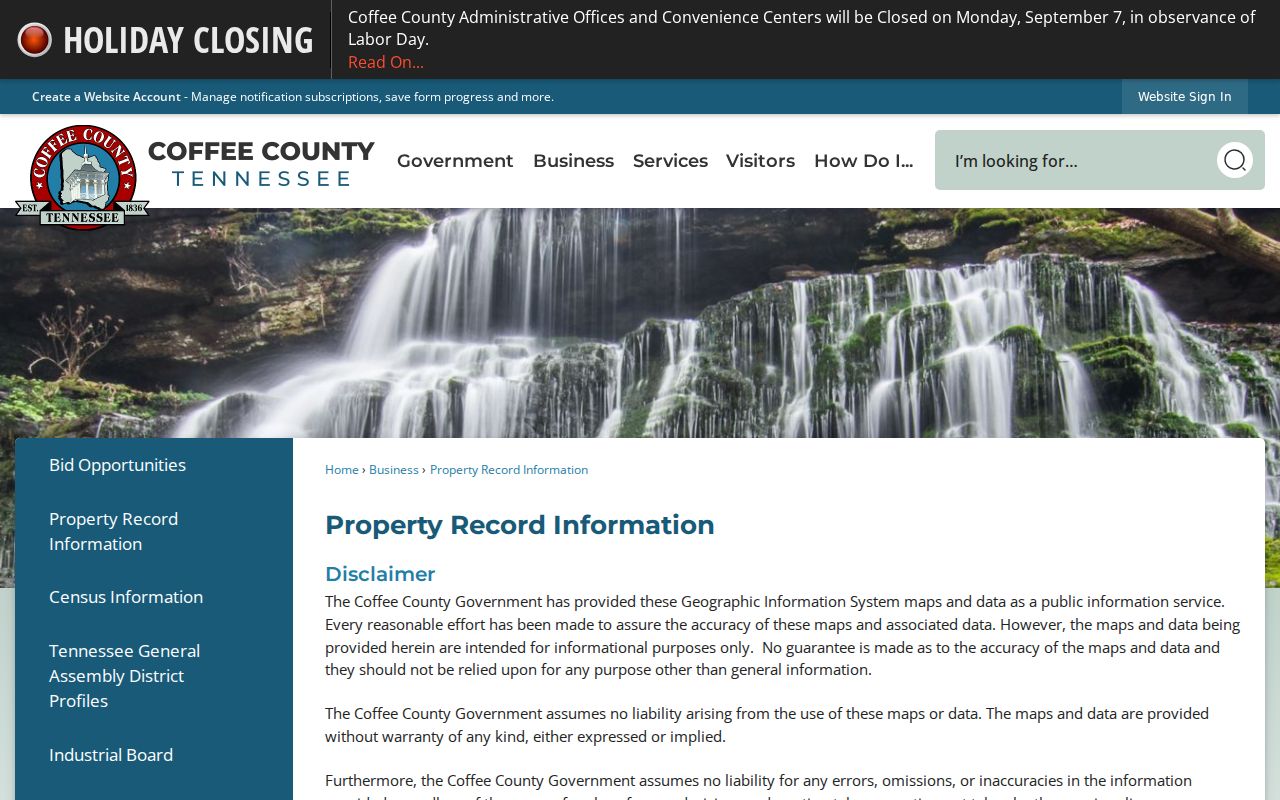
The Coffee County Property Record Information page is the practical first stop for a Coffee-side Tullahoma parcel. Its linked assessment application was blocked during research, so do not assume its live search controls or results. The county confirms property-record and GIS access, and the assessor's documented work includes tax rolls, tax maps, ownership records, taxpayer indexes, and assessments. When an online result is missing, call or visit the proper county assessor rather than filling gaps from a map image.
The Coffee property-record landing page is the documented entry point to its assessment resources.
On the Franklin side, the assessor documents a public terminal and cards that can include street address, owner, parcel ID, mailing address, subdivision or lot, values, and transfer data with deed volume and page. The Coffee card may not display the same fields. A tax-roll mailing address can help locate a recorded owner, but it does not prove that person occupied the parcel.
Note: Save the situs address, parcel ID, lot, and legal description together because one field alone may change over time.
Tullahoma Deed Index Divide
The two county systems have different published online limits. The Coffee County Register of Deeds records deeds, deeds of trust, mortgages, liens, plats, leases, judgments, powers of attorney, wills, court orders, and other notice instruments. Its site links a search service, fee material, recording requirements, and a fraud alert, but the research did not establish the public index's start year or field list. Treat Coffee's online cutoff as a call-ahead question, then use the office counter, deed books, microfilm, or a records request where appropriate.
Franklin's published guidance is clearer. Documents recorded since July 1998 are viewable online, while older material is being added or indexed back to an 1883 deed book and a 1965 trust book, with work toward 1807. Its online index is name based. For an address search, Franklin directs people to the assessor at 931-967-3869. That is a useful comparison, not evidence that the same fields or coverage apply on the Coffee side.
The Coffee Register of Deeds site provides the official route to its search links and recording resources.
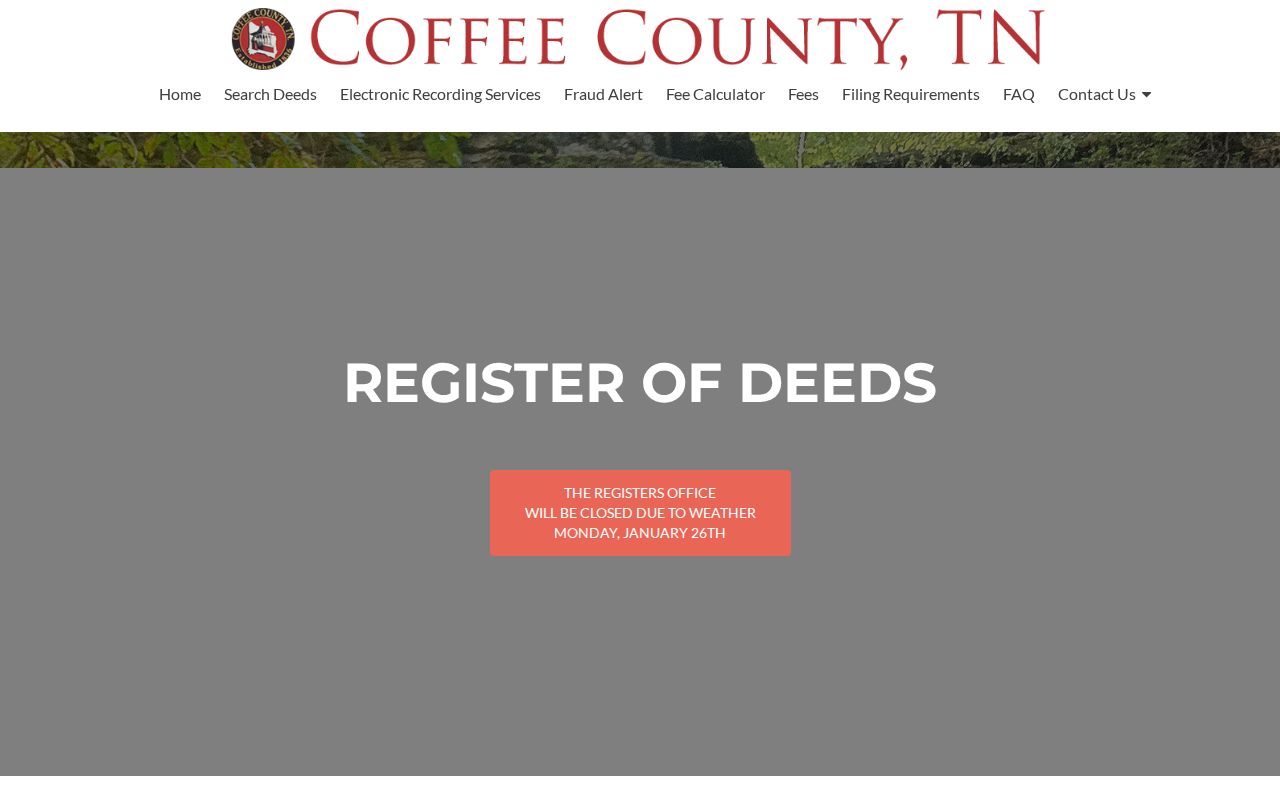
That office also offers a fraud-alert service that sends a subscribed person an email when a lien is recorded in the subscribed name. It is a protective property-record service, not a way to search past residents.
Tullahoma Previous Residents by Era
Published directory years are sparse, but the archive fills many intervals. The Tullahoma Advantage Preservation archive has a main search field, added query controls, title browsing, and decade browsing. Its dated title runs include Tullahoma News, Tullahoma News And Guardian, and The News. Search a full name with a street, spouse, funeral home, church, school, or business. Then confirm the issue's date and title before treating an address mention as part of the household trail.
Tullahoma History Archives offers a separate title search, A-Z browsing, and a time slider spanning 1870 through 2029.
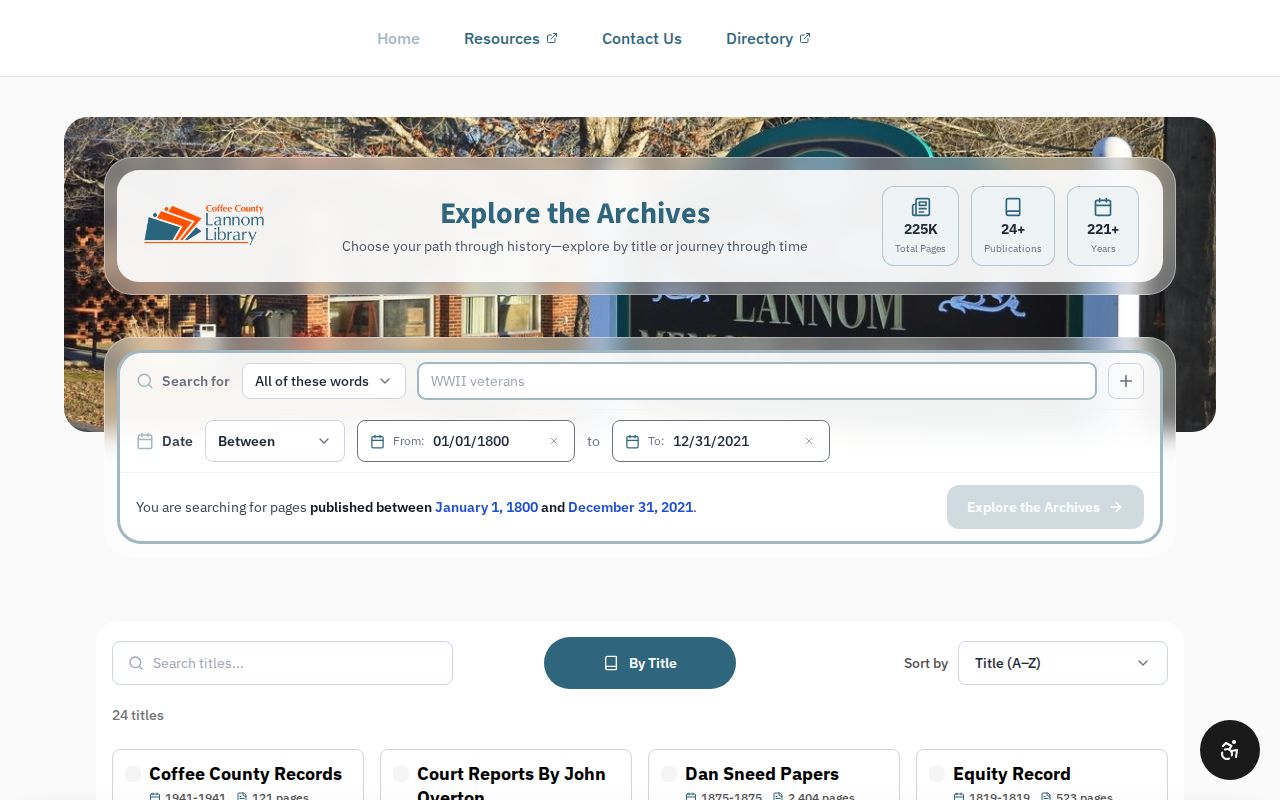
The archive interface is a discovery tool. It did not expose a directory-specific catalog or sample resident entry during research. Pair every result with the publication scan, a directory volume, or an original county record before adding it to an address history.
Note: Retain the title, date, and page image because a search result alone does not establish context.
Tracing Tullahoma Deed Chains
A chain of title is the sequence of recorded transfers tied to the same land. Begin with the current owner and parcel record, then find the current acquisition deed. The deed's source-of-title clause, legal description, lot or subdivision, and prior book/page are often stronger bridges than a street number. In this work, a grantor is the party conveying an interest, and a grantee is the party receiving it. Search the seller as an earlier grantee to move one transfer back.
- Collect the current situs address, owner, parcel or map number, subdivision or lot, and any transfer book/page from the assessor.
- Find the current purchase deed through the proper Register of Deeds using the owner name and available source details.
- Copy the grantor, grantee, instrument type, legal description, recording details, and source-of-title reference.
- Search the prior seller as a grantee, then repeat the process for the earlier instrument.
- At an online cutoff, continue with the recorder counter, deed books, microfilm, or a digitized TSLA or FamilySearch route when that book is available.
Copy the page or instrument reference before moving to the next transfer. The connection must remain traceable even when the street number is absent from an older deed.
- Grantor and grantee
- The party giving an interest and the party receiving it in a recorded instrument.
- Chain of title
- The linked sequence of transfers for one parcel or legal description.
- Legal description
- The lot, subdivision, metes-and-bounds, or other land description used to identify property beyond a casual street address.
Tullahoma Past Household Sources
Past residents are not always the people named on deeds. Use the verified Polk issues as snapshots, then pair a directory year with the nearest public federal census. The latest fully public decennial census is 1950 under the 72-year rule. Household composition and occupation can help distinguish same-name people, but a directory entry may also name a boarder, widow, business, or another household member. Never convert a directory listing into ownership without a land record.
For a simple process flow, use address or surname in a Polk issue, then the nearest census, then the Lannom archive for a dated notice, then an obituary or probate record: Polk entry to census household to dated notice to estate or burial evidence. The collections themselves are described in the Tullahoma City Directory resource. TSLA's Coffee list also identifies Daves Culbertson Funeral Home records from 1914 through 1986, Tullahoma Funeral Home day records, Oakwood cemetery inscriptions, historical voter registration, surveyor material, and deed genealogy volumes.
Note: A death notice can identify relatives, but a probate order or recorded deed is stronger evidence for an heir or land interest.
Tullahoma Address Continuity
Old addresses break in predictable ways. A directory may abbreviate a street, use a route or box address, apply Tullahoma as a postal place outside the incorporated line, or show a house number that later changed. The research found no verified local street-renumbering year. Do not invent one. Instead, bridge uncertainty with the legal description, parcel number, subdivision and lot, adjoining owners, map features, and the county that assesses the parcel.
Sanborn maps are useful for the physical side of the question. They can show building materials, stories, doors, hydrants, nearby institutions, and block layout. They do not name every resident. The research did not locate exact Tullahoma edition years or sheets in the Library of Congress catalog, so ask a library or archive to verify the needed edition before relying on a map for an address date.
Older source labels need the same care. The Lannom archive hosts county minutes, tax books, surveyor books, marriage books, and other titles beside its local newspapers, but some hosted works are from outside Coffee and Franklin counties. A title search hit is only a lead until the scan itself identifies the right county, date, and record type. When an address appears in a map or directory but not in a deed, compare nearby landmarks and adjoining parcels before treating the two references as the same place.
Tullahoma Previous Records Gaps
Coffee County was formed in 1836, and TSLA reports a courthouse fire in 1876. A complete official list of the lost or reconstructed record series was not found. That means early research should be built from named surviving sources, such as county books, published indexes, deeds, probate, cemetery records, newspapers, and FamilySearch images where available. Do not smooth an undocumented gap into a continuous owner or household history.
The Coffee Historical Society, Lannom Library, local newspaper archive, TSLA, and county recorder together form the local fallback chain. Ask about reverse directories, phone books, yearbooks, obituary indexes, map books, vertical files, and newspaper microfilm. No official Tullahoma library house-history guide or fee-based research service was located, so a referral request is more accurate than assuming the library performs a full property investigation.
Lawful use. Tullahoma past-resident research is suited to family and address history, estate questions, and personal curiosity. Do not use a public record to harass, stalk, or track any living person.