
Tullahoma City Directory Collections
There is no verified online catalog listing every Tullahoma directory, reverse directory, phone book, yearbook, or obituary index. The confirmed starting shelf is the regional Polk run identified by the Tennessee State Library and Archives Coffee County guide. Those volumes cover Coffee and, in some editions, Franklin and Bedford counties, which matters because Tullahoma reaches into both Coffee and Franklin counties. They are useful name-and-address snapshots, not proof that every local household was listed.
| Collection | Years | Where held | Access |
|---|---|---|---|
| Coffee & Franklin Counties Regional Polk directory | 1998 | TSLA or library catalog reference | Alphabetical regional snapshot; inspect the edition |
| Coffee, Franklin & Bedford Polk directory | 2004-2007, 2009-2015 | TSLA or local library | Name, address, and business trail; later 2017-2020 listing needs confirmation |
| Polk City Directory, Coffee County | 2003 | TSLA or local library | County and city name/address lead; inspect fields in the volume |
| Tullahoma newspaper titles | 1946-2021 across title runs | Lannom digital archive | Free keyword, title, and decade searching |
| Historical Society publications | Publication era from 1970 | Society, libraries, and TSLA | Local history and genealogy referral material |
For a gap between Polk issues, move sideways rather than guessing. The Lannom digital archive holds searchable local newspapers and selected books and minutes. Its newspaper titles overlap, so note both the title and publication date when you save a clipping. The separate Tullahoma History Archives offers title browsing and a time slider, but its directory-specific holdings were not exposed in the research.
Tullahoma Polk Directory Years
The confirmed Polk pattern is uneven: 1998, 2003, 2004 through 2007, and 2009 through 2015. A later locality-guide listing reports 2017 through 2020, but its exact shelf or copy still needs confirmation. That uncertainty is worth preserving. It is better to ask a librarian for a specific year than to treat a catalog mention as evidence that every annual volume exists or that it contains a reverse section.
Use the county names as part of the search. A person described as living in Tullahoma may appear in a Coffee-and-Franklin regional volume, while a parcel or election record routes to one county. The 1998 regional directory is especially useful as a fixed starting point, followed by the 2003 Coffee County issue and the later regional issues. Compare initials, spouse notation, address, and occupation only after looking at the actual page.
Note: A directory year marks publication timing, not the exact day a person arrived, left, or changed households.
Tullahoma Newspaper Archive Searches
The Lannom archive gives the directory hunt a deeper local layer. It lists Tullahoma News from 1946 through 2013, Tullahoma News And Guardian from 1949 through 2009, and The News from 2013 through 2021. The News And Guardian run alone lists 165,533 pages. Search a surname with a street, church, school, funeral home, business, or event, then open the image and confirm its title and date before connecting it to a household.
Archive results can also include books and minutes that are not necessarily Coffee or Franklin material. A hosted title is not automatically a Tullahoma record. Search the exact place, read the scan's title, and pair a promising item with a Polk volume, census, deed, or obituary. That small check avoids building a family line from an unrelated county book.
Tullahoma Historical Society Research
The Coffee County Historical Society operates a research room in the historic Coffee County Courthouse at 101 West Fort Street in Manchester. Its holdings and referrals cover local history, genealogy, churches and cemeteries, schools, businesses, photographs, and publications. The Society says its Coffee Chronicle and special publications can also be consulted at the Society, Manchester Public Library, Tullahoma Public Library, and TSLA. It is a good fallback when the online directory shelf does not identify the year you need.
The Historical Society's resource page outlines the research setting and its local collections.
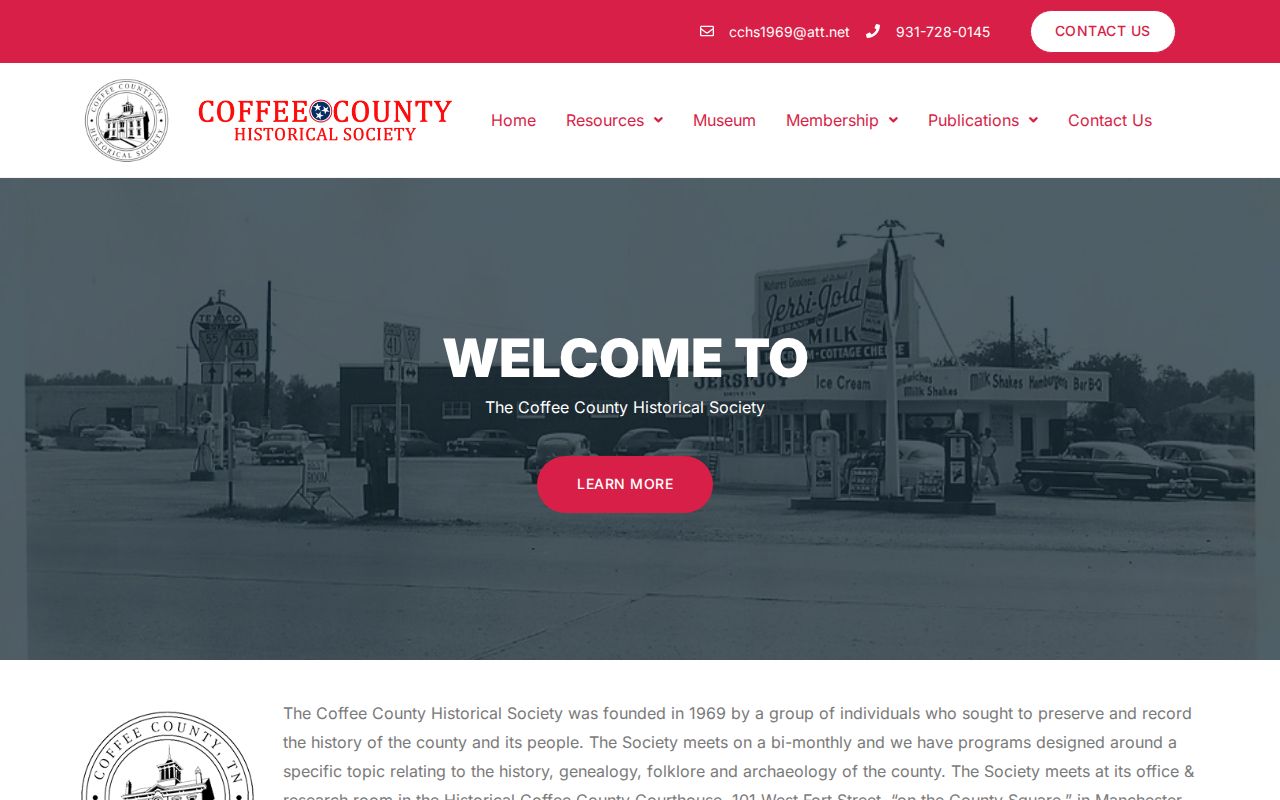
The Society also reports that more than 100,000 Hugh Doak photographic negatives are being scanned, with indexes still in progress. A caption or street scene can supply a useful lead, but it should be checked against a dated newspaper or original public record.
Reading Tullahoma Directory Entries
No digitized Tullahoma Polk page was openly viewable during research, so an entry must be read cautiously. The verified collection descriptions support treating a typical Polk entry as a possible combination of name, given name or initials, spouse or household notation, address, telephone number, occupation or employer, and a printed ownership indicator. The exact printed abbreviations, the presence of each field, and reverse-page availability can differ by edition. Photograph the page heading and abbreviation key with the entry.
| Name line | Record the spelling, initials, suffixes, and any spouse or household notation exactly as printed. |
|---|---|
| Street address | Use it as a dated location clue, then compare it with a deed or assessor situs address. |
| Occupation or employer | It may appear in an edition, but confirm the local volume before relying on it. |
| Telephone or ownership mark | These may appear in some editions; save the edition's key before expanding an abbreviation. |
| Volume context | Keep the year, publisher, page, and whether the entry is alphabetical or street ordered. |
- Criss-cross directory
- A street-order section that can connect an address to a listed occupant or business, if that edition includes one.
- Householder index
- An index organized around a household or address rather than a simple surname list.
- Abbreviation key
- The legend printed in a volume that explains shortened labels; it must be read from the same edition.
Tullahoma Directory Name Clues
Local institutions can make a name search more precise. Search the full and shortened forms of University of Tennessee Space Institute, Arnold Air Force Base, Tullahoma Area Airport Authority, Tullahoma Utilities, City Hall, Lannom Library, Oakwood Cemetery, and C.D. Stamps Recreation Center. The research identifies these names as recurring local context in newspapers, directories, public notices, and photographs. A result can establish a public affiliation or event context, but it does not establish a private address or family relationship.
The Tullahoma Area Chamber directory adds a public business and civic layer with keyword, category, and A-Z searching. It includes categories such as government, service organizations, churches, funeral homes, schools, museums, utilities, and businesses. It is member-submitted and business focused, not a household roll. Likewise, UTSI's Mason Library is a specialized institutional-history resource with bound volumes, government and industry reports, and microform, but no public alumni or personnel directory was confirmed. Use these sources to sharpen a search term, then verify the person in a dated primary record.
Tullahoma Directory Shelf Gaps
A missing name has several ordinary explanations. The person may have moved, used an initial, lived outside the volume's coverage, been omitted, or appeared under a spouse's name. An alphabetical directory should not be assumed to have a reverse or criss-cross section. The research did not verify which Tullahoma volumes have one. Ask the library or TSLA to inspect the edition itself, including its front matter and street pages.
The city has another practical gap: it crosses Coffee and Franklin counties. Searchers should not force a result into the Coffee side simply because the mailing place says Tullahoma. For current address-keyed evidence, use the appropriate assessor and recorder after identifying the parcel's county. The modern sequence is different from the historical-shelf work, so the Tullahoma streets resource is the better route for a current parcel trail.
Note: Ask for the title page and abbreviation key with any directory entry you plan to cite.
Tracing Tullahoma Households
Work one household at a time. Start with the nearest confirmed directory year, then move forward and backward through the available Polk issues. Keep each spelling, initial, spouse notation, address, and printed symbol in a small timeline. When the name disappears, search the street first if the edition has a verified reverse section, then use the local newspapers for an address announcement, obituary, school notice, or civic reference.
- Choose a known surname or address and the closest confirmed directory year.
- Copy the entry with its page, volume, title, and every visible abbreviation.
- Check the prior and following available volumes for a move, spelling change, or separate same-name entry.
- Pair the dated address with the federal census, public through 1950 under the 72-year rule, to test household composition and occupation.
- Use an obituary, funeral record, deed, or probate record to bridge a departure or death.
TSLA lists Daves Culbertson Funeral Home records for Tullahoma from 1914 through 1986, Oakwood cemetery inscriptions published in 1936, historical voter registration for the Tullahoma 13th District from 1899 through 1903, and African-American census transcriptions for several early decades. These are named historical aids, not a current resident roll. The Tennessee probate collection can add an estate or representative when images or an index are available.
Coffee's 1876 Records Break
Coffee County was formed in 1836, and TSLA reports that its courthouse burned in 1876. The research did not locate a complete official list of the series or years lost in that fire. That is a real historical limit, not a reason to say that all early records vanished. Surviving or reconstructed books, published indexes, newspaper scans, deeds, probate material, cemetery publications, and family collections need to be reconciled one by one.
- 1836: Coffee County was formed from Bedford, Franklin, and Warren counties.
- 1858: Tullahoma was incorporated, creating its municipal records layer.
- 1876: the Coffee County courthouse fire created a documented but not fully itemized records gap.
- 1946 and 1949: the earliest listed Tullahoma newspaper title runs begin in the digitized archive.
- 1998 onward: confirmed regional Polk volumes provide later printed snapshots, with gaps between issues.
Tullahoma was incorporated in 1858. Later newspaper digitization provides a much fuller discovery layer, while the Tullahoma History Archives has browsing controls from 1870 through 2029. This contrast is useful when a city directory search ends abruptly: follow the source that exists for the year at hand, and preserve the gap when no source has been verified.
Note: A repeated surname in a directory or index does not prove that two people were related.